by Toby

100_4810

My name is Toby T-O-B-Y.  I like baseball.  I like batting the ball, throwing the bat and running around the bases. 

My friends are Levi, Miriam, Eli, Jack and Becca. I like eating at cut-cut-flip-flip (BD’s Mongolian BBQ- for the record, no its not really Mongolian but it is tasty) and Heckenbecks (we’re not sure where this name came from- its Modern Nomad but he calls it Heckenbecks- good food).

I can add that the kid can hit!  He’s got a good eye for the ball. 

by Mark

The Mongolian language has a fascinating history.  It is part of the Altaic language group, other languages in this family are Japanese, Korean and Turkish, I have also heard that Finnish has some relation but not clear exactly how it fits. 

The alphabet as is used now in Mongolia is Cyrillic or commonly known as Russian (see the title above).  It was an alphabet created by monks working to translate the Bible into Slavic languages sometime in the first Millennium.  There are some letters that correspond to Greek, such as X chi- more of an aspirated back palatal (for those of you who are into those things) As in the Spanish pronunciation of Mexico, the X is the same sound.  The Cyrillic alphabet was applied to Mongolia in 1924 when Mongolia became the first Soviet Satellite.  The Soviet method of contextualization  was pretty straight forward- Be Russian.  (about 80% of Mongolians speak Russian, Darhan was built by the Russians.  In fact it may help you to think of Russia and Mongolia in similar relationship of the US and Mexico.  Many Russians shop here because its cheaper and many Mongolians work in Russia in order to make more money than the can in Mongolia)

100_4827

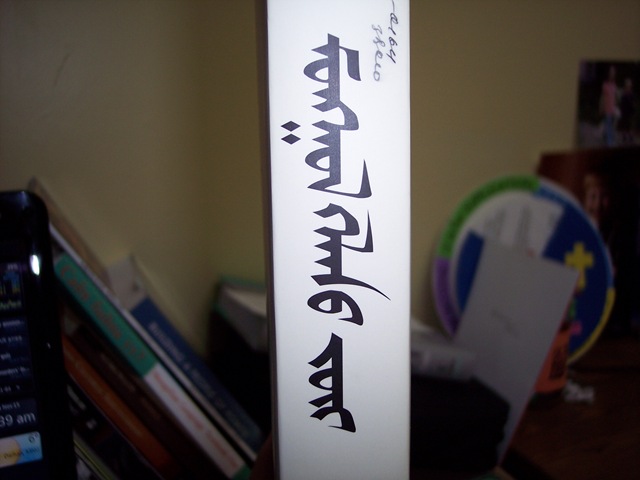
Classical Mongolian from a Mongolian language grammar- the first word (top) is Mongol or Mongolian

On the one hand Mongolia is a literate society with literacy rate in the 90% (I can’t remember exactly- check Wikipedia if it bothers you).  There are beautiful Mongolian poems and songs and literature available in Mongolian.  On the other hand Mongolia is still a very oral driven society- meaning it is not a book based society.  People read, but not to the extent that I have seen in Europe or the US.  In some ways to counter this I see music and song, ballad type songs playing  much more important role here than the West.  A man who has a beautiful voice and can sing well has great honor here. (I need to find another way to be honorable) The nomadic lifestyle did not necessitate books and it was only after Chinggis Khan started conquering that he saw the great need to record the conquests in written form.  This brings us to Hochin Beetchik or the Old Writing.  Which I will say straight out I am fascinated in a Lord of the Rings, elven writing- how cool is that way. (Warning Rabbit Trail: Many Scandinavian countries noticed similarities between Mongolian writing and Nordic ruins- what Tolkien used.  They organized many expeditions through Mongolia to see if there were links that could be established, there were not) The calligraphy of Classic Mongolian is a thing of beauty and quite unlike any other alphabet I have seen.

100_4822

Our Names in Classic Mongolian

Chinggis needed a writing system and so two Syriac monks came up with the alphabet, you can see the examples below.  It looks much like Arabic to me and seeing the influence of the monks background it is no coincidence. (I have heard conflicting stories as to the origin of the alphabet and reserve the right to be wrong) The earliest writing in this style dates back to 1227, it is classed as the Sogdo-Uighur alphabet.  I have heard that each word reflects the image of a horse, with its ears at the start of the word and tail flowing at the back.  Its interesting that it is written vertically (like Chinese)but also read horizontally.

The difficulty is that Cyrillic was not an exact match to the sounds.  There are Russian sounds that there is no equivalent in Mongolian.  (the whole evolution of this language would be fascinating- we learn just as many Russian words in vocabulary as Mongolian.  The word that is used is usually whatever is shorter- good Doctoral thesis right there)

The old writing is used in Inner Mongolia- part of China, but I have heard different comments on who can actually read it.  Schools are teaching the old writing now to students and in time I think it will become more promanint in Mongolia.  There was supposed to be an “official” return to old writing at the 800th Anniversary of Mongolia but it was pushed back.  Our teachers know the classic writing and I would like to study it a bit but that is far into the future (I need to learn first how to say something more than- “my name is Postage Stamp [that’s what Mark means in Mongolian but its ok I met a guy the other day named Mahlgai, or Hat]”  Its surprising but your computer has the ability to write in Classic Mongolian and Cyrillic, you can change it under the control panel section.

For more information or to see what the alphabet looks like check out these two Wiki articles

http://en.wikipedia.org/wiki/Mongolian_writing_systems

http://en.wikipedia.org/wiki/Mongolian_script

100_4813

OSHA has determined that bricks may pose a significant risk to individuals using them to support vehicles.  Please be advised. 

Anthropological reflections on Mongolia by Mark


Sorry, this isn’t a political post.  Instead I wanted to share a few things on being in a different culture and trying to figure out why some things are they way the are in Mongolia.  The creed I learned from Jim Eberline on culture has served me well, “Its not wrong, just different.” 


Every day as we go to language school we get a glimpse of a mural on an apartment building behind the school, its pictured below.

Look at it and ask yourself the question- what is it, what does it mean?

100_4623


I’m fascinated by the mystery of this mural.  I don’t know when it was put up but probably some time in the past 30 years or so.  My first thought was “What is the Virgin Mary doing on a mural in Mongolia?”  This mural would be at home in Mexico, where I have seen a few like it, or even some places in the US.  It appears that there is a woman holding a child.  I’ve asked my teacher who it is and she says she doesn’t know.  Its not Genghis Khan, who adorns everything else here so I’m still left with the mystery of who it is, why is it here?  What does it mean?  I don’t know.  Just because someone lives in Mongolia doesn’t mean they know either.  There are many things that we do in our respective cultures that we do but don’t always know why we do them, nor do we attribute any special significance to them but they are different from other cultures.  Not wrong, just different. 

Another interesting thing a learned this week is about directions.  If I were to ask you what left and right mean in regards to directions on the compass you would probably reply Left is West and Right is East.  Most western cultures are established on a Northern orientation.  When the United States was being settled we knew about Magnetic North and used a compass.  In Mongolia the opposite of the directions is true.  Left is East and Right is West- a Southern orientation.  The question I have is why? There may be a few different reasons.  When a ger (the circular tent that is lived in, you can see one above) is set up the doorway is always chosen to face south.  This catches maximum light and warmth.  Also if you think about how Mongolia is situation the North is only cold (Siberia is up there and besides mosquitos and nuclear waste – that makes bigger mosquitos  there still isn’t anything there- look on a map at the size of Siberia compared to Russia!).  The south here is  much more favorable position.  This throws me allot when I think about directions, keeping it straight in my head.  Its definitely different, not wrong, just different. 

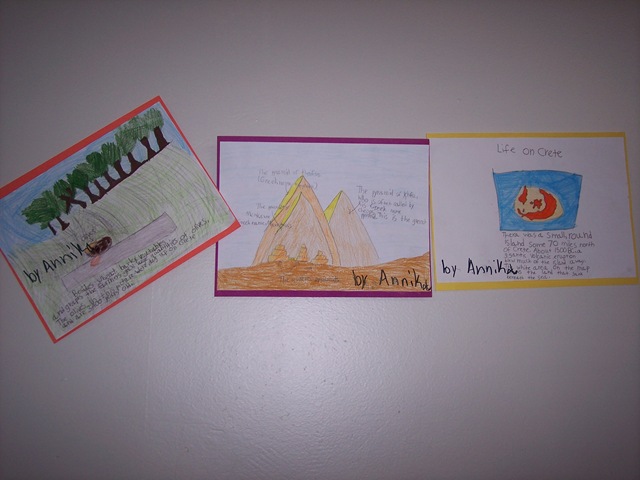
Annika recently had an open house at her school, we wanted to share some pictures with you of the assembly and recent work.

100_4783

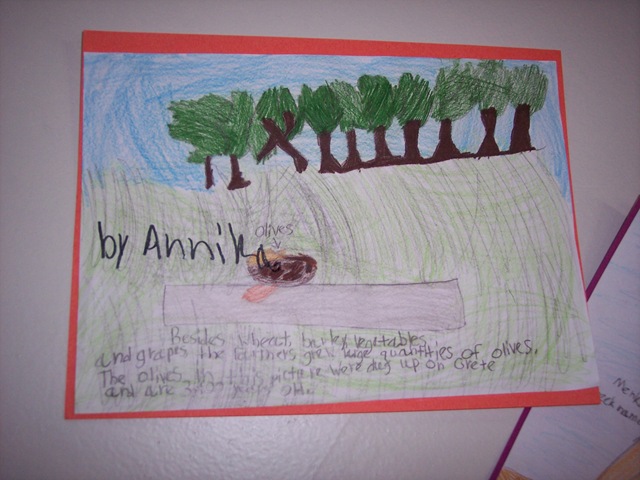
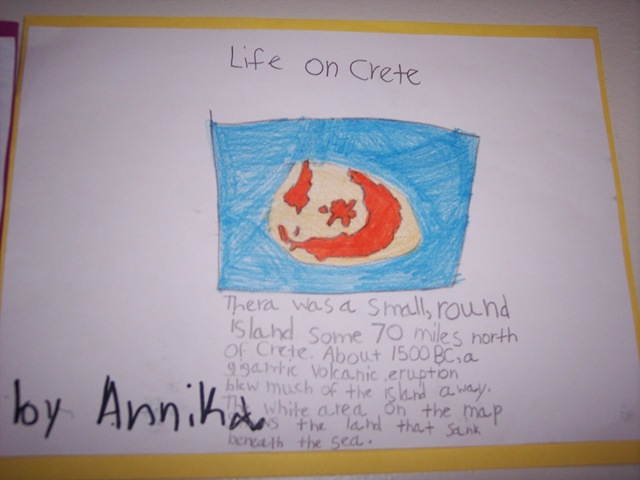
A sample of her work- look at the social studies aptitude! (from a former social studies teacher)

100_4785


100_4784

100_4786

100_4792

The Class

  100_4789

A science experiment

By Mark


My heart sunk as I read the text on my phone, “Bodio’s baby just died.”  Sukhee and Bodio are a young couple married a year ago.  They represent the future of leadership in the church.  Their baby Itgell was about three months old.  Bodio worked at CLTC (Church Leadership Training Center- the new name for ABTC).  Itgell was by her side as she worked. 

The child’s temperature was running a high temperature.  The took their baby to the hospital but it was too late, she died a short time after their arrival.  Meningitis is the suspected cause of death.  I went with several that Friday evening to visit them in Tusgon- a ger community of Darhan.  As we prayed with them I was reminded that hope in Christ is not just a future thing but a reality and truth that impacts how we live now. 

 Although the church was established over a decade ago there is still a struggle in understanding of what Christian funeral looks like in a Mongolian context.  There is work being done and there is more needed- please pray for wisdom and discernment in this important testimony of hope in a period of grief. 

Funerals are held on Monday, Wednesdays and Fridays usually early in the morning.  We left the apartments at 5:10 AM to go to Bodio’s parents house.  We would then travel to the morgue for the body to be prepared for burial and a short service.  When we arrived at the home food was being prepared and allot of it.  Traditionally many people gather at the home to eat after the funeral, however this time people would be gathering at CAMA services. 

The morning seemed to grow colder as dawn approached.  As we arrived at the morgue around 6:30, two other funerals had already been held ahead of us.  We waited outside as the grandparents went inside to prepare the baby for burial.  The doors opened and we stepped inside.  The air was thick with incense, the smell of balsam.  The child was in a velvet coffin draped in a blue prayer flag.  Someone held a picture of the child.   

Itgell is a special name, it means “Believer.” Brent Liberda was asked to share the message and did an excellent job bringing home the truth of what belief means.  He shared Acts 4:12 “Neither is there salvation in any other for there is no other name under heaven given among men where by we must be saved.” We sang Amazing Grace together and than walked around the casket three times, clockwise to say farewell.  It was hard.  In the west we are very insulated from death – here there is no padding, it is raw and in your face. 

The parents were not to go to the grave site, in fact very few did.  There were many things that I do not know the significance of in the funeral.  I traveled with the Phams to the grave yard.  The grandfather tossed our rice and milk as we slowly made our way.  Five men rode in back of the truck with the casket, I can only imagine how cold they must have been.  It was probably around 15 F. The cemetery is far outside of town.  The right side of the hill is a favored spot which is where the grave was dug.  The truck carried the headstone.  Sand, gravel cement and stones were already at the grave side.  Sand was put down, dirt and cement- we each placed handfuls of soil into the grave.  A candle was lit and placed inside a small metal ger.  White stones were placed on top of the grave.  The stones marked out grave sites from one side of the valley to the other.  More rice and milk was offered. 

We drove away from the graveyard by another road, careful not to cross over the previous route.  Two fires were lit and the vehicles drove in between them and stopped.  Everyone got out and washed our hands in milk water, was given sugar that we dipped into a bowl of milk.  The vehicles then made their way back to CAMA.

That night on television I watched choral recital from the Netherlands.  I listened to a beautiful choir sing This is My Story, This is My Song in an ornate church with gold all all around.  It was beautiful but I wondered if they believed a word of it.  I thought back to that morning the melody of Amazing Grace echoing in my head in the room of the morgue.  They knew more than the words. 

by Cinda

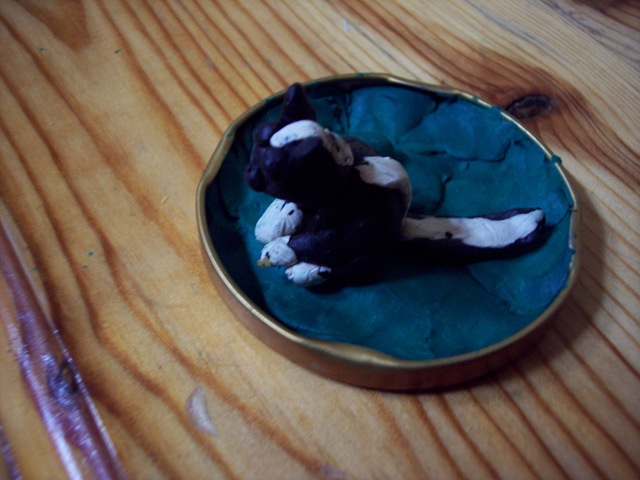
Since we have dedicated the last few entries to Toby’s recent experiences, we thought it was time to give Annika some more attention!  She is doing great in Mongolia.  She has several good friends and has a lot of time to play with them since most of us live in close proximity.  Averiana is now living just a few doors over from us, so she and Annika play together along with Isaiah nearly every day after school.  Now that it’s getting colder we’ll have to find some fun things to do inside.  Last weekend when we were school supply shopping for Toby we found paints and modeling clay for them to use at home.  Those of you who know Annika understand that she HAD to have these craft items, and it has turned out to be perfect timing for new “stuff” since the weather has gotten quite chilly lately.  Annika put her skills and craft supplies to good use, creating a cute little skunk which is pictured somewhere on this page.  She has other designs in mind, including a volcano for Toby (his latest interest).  100_4761

On Wednesday afternoon Annika’s friend Sophie was able to come over after school for some play time.  Sophie’s family has been in Mongolia for many years, but they are new to Darhan and she and her brother and sister attend the Alliance MK school where Annika, Averi, Isaiah, etc. all attend.  Annika was thrilled to meet Sophie and her sister Leah, who both have their American Girl dolls with them here in Mongolia.  Wednesday afternoon was full of giggles and hair brushing, doll 100_4759dressing, fingernail painting and more.  Then they spotted a lonely little puppy sleeping outside our window in the cold rainy weather, so they ran out to care for it.  Since Annika has been asking frequently (okay, constantly) to Please, please, please have a pet, I had gone out to see it earlier in the day — however, it seemed to be the typical Mongolian breed, which would grow to be much too large for our small home.  None of us like to see a puppy suffer, however, so we did try to feed it and warm it; Averi took it home for awhile to warm

it up and the girls enjoyed playing with it over there.  Now it’s Saturday night and Averi, Isaiah, and Malachi are here watching Tom and Jerry cartoons with Annika and Toby.  It’s getting dark earlier each day, and that coupled with the frigid wind makes playing outside after dinner no longer a good option.  

Annika says she really likes it here in Mongolia.  She’s growing like a weed, doing well in her school work, and having a lot of fun with her new friends.  Every week her class studies a different region of the world, which includes a geography test.  Annika impresses us with her ability to remember the names of each country.  This past week was a difficult test over the countries of Equatorial Africa — it’s hard enough to just read the names of those countries, let alone remember them all for a test, but she did it!         100_4755

100_4742

100_4743

Toby is floating off the ground he’s so excited!

100_4748

On the way to the classroom

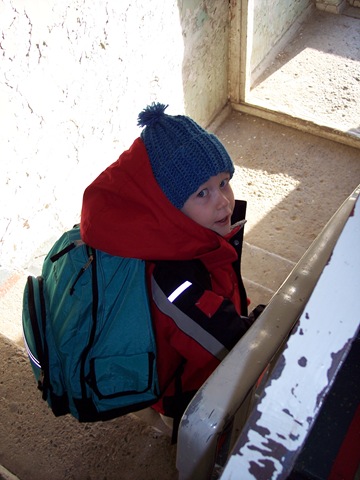
Toby had his first day of Mongolian pre-school today.  He and Levi arrived at the same time and were the first two children in their class, so they enjoyed having the room and toys to themselves.  They are in an upstairs classroom with many windows, so it’s bright, sunny and cheerful.  Having new toys to play with and a big sunny room to play in seemed to suit them both well.  There’s an attached room with a lot of little beds for naptime, but we will bring Toby home each day as soon as we’re done with class so he’ll take his nap at home.  When it’s too cold to play outside, there is at least one large play room in the building as well as slides and toy rooms in various places along the hallways — that’s going to be so much better for them than being confined to the small space of the apartment all day!  Thanks for praying, and continuing to pray.  We hope he will soon begin to try the food they serve.

We would appreciate you praying for Toby and our family.  Monday we will  be putting Toby into Mongolian pre-school for a half-day.  He is excited about all the school supplies and does well in new social situations, the tough thing is that it is all in Mongolian.  There will be two other American families putting their kids in also.  Because of some issues with child care it became clear that this was the right time to have Toby enter tsitserlik (pre-school).  Please pray for a good transition and for Toby to pick up the language quickly, and that he would bravely taste the Mongolian food.  Also pray for Cinda and I to have peace through this time.